
Table of Contents
- Why Renting Medical Equipment Locally Beats Waiting for Delivery
- Try Before You Buy Medical Equipment: Test Fit and Function in Person
- Short-Term Medical Equipment Rental: Flexibility for Recovery and Respite
- Durable Medical Equipment Insurance Coverage: What to Know Before You Rent
- Cost Savings and Financial Flexibility of Local Renting Medical Equipment
- Hygiene and Sanitization Standards You Should Expect from a Local Provider
- Logistics of Local Delivery, Setup, and Pickup
- Frequently Asked Questions
Last Updated: September 14, 2026
Why Renting Medical Equipment Locally Beats Waiting for Delivery
Renting medical equipment locally means you can walk into a showroom, see the actual durable medical equipment (DME), and take it home the same day instead of waiting on a shipment. For anyone facing a short-term recovery or caring for an aging parent, that difference matters more than most online listings admit.
This guide from Med-Tech Inc covers the practical case for renting medical equipment nearby: what it saves you, how to judge a provider’s hygiene standards, and how to handle insurance questions before you sign anything.
The core argument is simple. Online sellers win on price per unit and lose on everything that happens after the box arrives. A hospital bed, wheelchair, or patient lift has to fit a specific body, a specific doorway, and a specific recovery timeline. None of that can be resolved through a product page.
- Same-day availability for post-operative care and hospital discharge
- Physical fit testing before you commit
- Local service and adjustments when something isn’t right
- No long-term capital expenditure on equipment you’ll use for weeks
The Centers for Medicare & Medicaid Services guidance on durable medical equipment treats DME as a defined category with its own coverage rules, which is why the paperwork matters as much as the product.
Try Before You Buy Medical Equipment: Test Fit and Function in Person
The single biggest advantage of a local showroom is the trial period. You can test a walker’s grip height, roll a mobility scooter through a mock doorway, and confirm a lift’s harness actually suits the patient before any money changes hands.
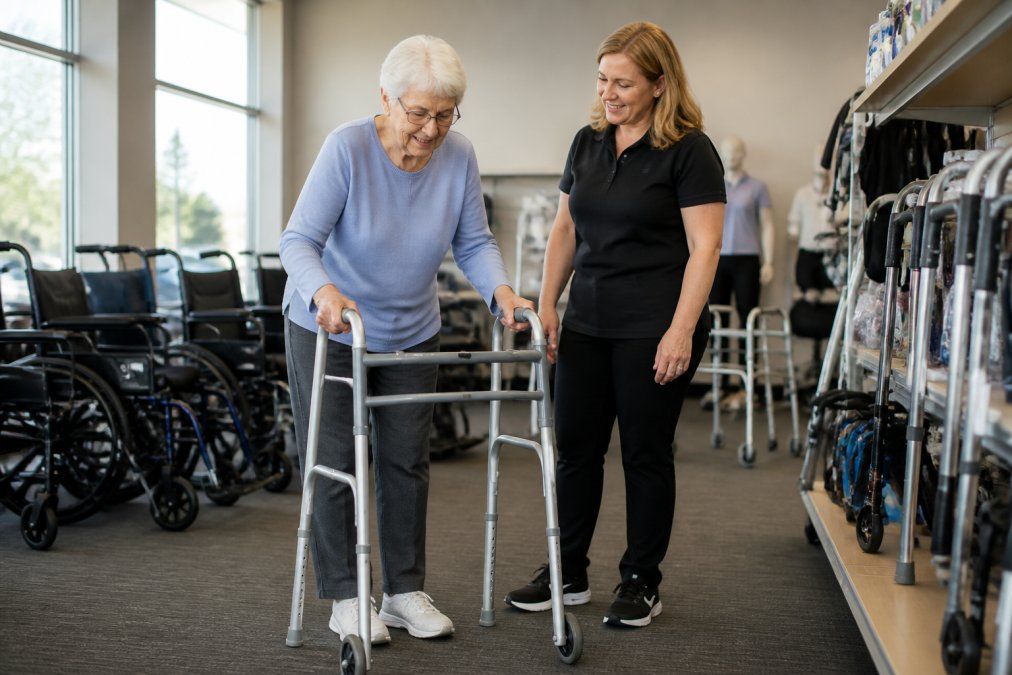
A common mistake is ordering based on specifications alone. Seat width, seat-to-floor height, and turning radius look fine on paper and fail in a hallway. Testing in person catches those problems in ten minutes rather than ten days.
At Med-Tech Inc, the try-before-you-buy approach exists precisely because fit is individual. Arthritis in the hands changes which reacher or walker grip works. A scooter that clears a standard door frame may not clear yours.
Bring your actual measurements to the showroom: doorway width in centimeters, the patient’s seated height, and the tightest turn in the home. Staff who work with mobility aids daily can translate those numbers into a shortlist fast.
Short-Term Medical Equipment Rental: Flexibility for Recovery and Respite
Short-term medical equipment rental matches the equipment to the recovery window instead of forcing a purchase that outlives its usefulness. Most post-operative care and rehabilitation periods are measured in weeks, not years, and rental contracts scale to that reality.
The practical benefits stack up quickly:
- Flexibility for short-term needs. Return the equipment when the surgeon clears you.
- Reduced maintenance and repair responsibilities. The provider handles servicing, not you.
- No storage problem. A hospital bed takes up a room. Renters give it back.
- Access to current models. Rental fleets turn over, so you’re often using newer equipment than a five-year-old purchase.
For family caregivers managing a respite period, this removes an entire category of asset management from the to-do list.
| Situation | Better Fit | Why |
|---|---|---|
| Recovery under 8 weeks | Short-term rental | No resale hassle, no storage |
| Progressive, long-term condition | Purchase or lease-to-own | Cost spreads over years |
| Uncertain fit or sizing | Rental with trial | Test before committing |
| Respite or temporary caregiver relief | Short-term rental | Matches the care window |
Durable Medical Equipment Insurance Coverage: What to Know Before You Rent
Durable medical equipment insurance coverage depends on your plan, your diagnosis, and whether the provider is an approved supplier. Medicare Part B generally covers DME that is medically necessary and prescribed by a treating practitioner, but the details of reimbursement vary by plan and supplier status.
Medicare’s official page on durable medical equipment coverage is the place to confirm what your specific plan covers before you rent.
The insurance-versus-out-of-pocket decision usually comes down to four questions:
- Is the equipment medically necessary and documented by a prescription?
- Is the supplier enrolled and recognized by your plan?
- Does the plan cover rental, purchase, or both?
- What is your remaining deductible and coinsurance responsibility?
The Rental-vs-Purchase Rule Most People Miss
For Medicare Part B, capped rental is the default path for many items of capped rental equipment, items like hospital beds, wheelchairs, and patient lifts. Under capped rental, the plan pays monthly rental amounts, and after a set number of consecutive months of rental (commonly 13 months for capped rental items), ownership of the equipment transfers to the beneficiary. That means a “rental” can quietly become a purchase if you keep it long enough.
This matters for two reasons. First, if your recovery is genuinely short, say six weeks after a knee replacement, you may never reach the ownership transfer point, and rental is the cleaner financial path. Second, if your need is open-ended, the capped rental structure means you may end up owning the equipment anyway, so it is worth knowing that going in rather than being surprised at month 13.
When Paying Cash Beats Filing a Claim
A common pattern is that filing an insurance claim for a short-term rental costs more in time, paperwork, and deductible absorption than simply paying cash. Here is a simple decision matrix:
| Your Situation | Likely Better Path | Why |
|---|---|---|
| High deductible not yet met, short rental | Cash | You would absorb the full cost anyway, minus the paperwork |
| Deductible met, medically necessary, enrolled supplier | Insurance | Plan pays its share; you owe only coinsurance |
| Rental under 30 days, low-cost item (walker, commode) | Cash | Claim admin cost often exceeds the rental itself |
| Long-term or capped rental item | Insurance | Capped rental can lead to ownership transfer |
| Supplier not enrolled with your plan | Cash or switch supplier | Out-of-network DME is rarely reimbursed |
Supplier Enrollment Is the Silent Deal-Breaker
A supplier must be enrolled in Medicare and recognized by your plan for the rental to be reimbursable. Many local showrooms are enrolled; some are not. Ask directly: “Are you a Medicare-enrolled supplier for this specific item?” The answer determines whether your claim has any chance of being paid.
Never assume a rental will be reimbursed retroactively. Confirm coverage and supplier status before the equipment leaves the showroom, or you may end up absorbing the full out-of-pocket cost. A signed Advance Beneficiary Notice (ABN) means the supplier expects the plan may deny the claim, read it before you sign.
Documentation You Should Have in Hand
Before the equipment leaves the showroom, you should be able to produce: a written prescription from a treating practitioner stating the item and medical necessity, the supplier’s enrollment confirmation, and a clear statement of your coinsurance and deductible responsibility. If any of those three is missing, pause the rental.
Cost Savings and Financial Flexibility of Local Renting Medical Equipment
Renting converts a capital expenditure into a predictable operating cost, and for short-term recovery that math almost always favors rental. You avoid depreciation on an asset you’ll use for six weeks, and you avoid the resale problem entirely.
The cost-benefit analysis is straightforward:
- No depreciation. A purchased mobility scooter loses value the moment it leaves the store.
- No maintenance schedule to fund. Servicing stays with the provider.
- No equipment lifecycle risk. If the equipment fails, it’s the provider’s problem.
- Predictable monthly outlay instead of a large upfront payment.
For facilities and hospice agencies, this also simplifies asset management across a rotating patient population. Scalability matters when census fluctuates.
Pricing depends on the equipment type, rental duration, and delivery requirements, so ask Med-Tech Inc directly for a current quote rather than relying on a generic online figure.
Hygiene and Sanitization Standards You Should Expect from a Local Provider
Sanitization protocols are where local rental providers separate themselves, and where most online listings give you no information at all. You are entitled to ask exactly how equipment was cleaned between users, and a reputable provider should be able to answer without hesitation.
Cleaning vs. Disinfecting: They Are Not the Same Thing
The words get used interchangeably, but they describe two different steps, and both matter.
- Cleaning removes visible soil, dust, and organic material using detergent and water. Cleaning must happen first, disinfectant cannot penetrate dirt.
- Disinfection kills or inactivates most pathogenic microorganisms on surfaces after cleaning, using an EPA-registered disinfectant appropriate for the device.
A provider that only wipes equipment down with a general-purpose cleaner is cleaning, not disinfecting. For high-contact surfaces on shared equipment, that is not enough.
What a Real Protocol Looks Like
What a reputable provider should be able to describe, step by step:
- Cleaning and disinfection between every rental, following the manufacturer’s instructions for each specific device, not a one-size-fits-all wipe-down
- EPA-registered disinfectants matched to the device surface, with the correct contact time (the wet time the disinfectant must stay on the surface to work)
- Documented sanitization protocols for high-contact surfaces like handgrips, armrests, control panels, and harness buckles
- Inspection before delivery for wear, damage, cracks, or missing parts, cracks in a plastic seat or a frayed harness strap are both a hygiene and a safety problem
- Clear records of when equipment was last serviced and sanitized
CDC guidance on cleaning and disinfecting medical equipment sets the general standard for environmental cleaning in healthcare settings. Ask whether your provider follows it.
How to Verify a Provider’s Hygiene Claims in Person
You do not have to take a provider’s word for it. Three things you can check on a showroom visit:
- Ask to see the cleaning log for the specific unit you are renting. A provider who tracks sanitization can produce a dated record.
- Inspect the high-contact surfaces yourself. Look at handgrips, armrests, and control panels for residue, stickiness, or discoloration. Clean equipment looks and feels clean.
- Ask which disinfectant they use and how long it stays wet. A provider who knows the product name and contact time is following a real protocol; one who says “we wipe it down” is not.
Hygiene is the question competitors’ websites never answer. A provider who can walk you through their disinfection process, by name, with a log, in person, is almost always the safer choice. If they cannot, that is your answer.
Why This Matters More for Rental Than Purchase
New equipment has never been used by anyone else. Rental equipment has. That is the trade-off you accept in exchange for lower cost and flexibility, and it is exactly why the sanitization protocol, not the price, should be the first question you ask a local provider.
Logistics of Local Delivery, Setup, and Pickup
Local delivery, setup, and pickup is the operational advantage that remote sellers cannot replicate. A hospital bed needs assembly. A patient lift needs a trained eye on the ceiling anchor or floor clearance. A scooter needs a walkthrough of the home’s thresholds.
Here’s what a well-run local provider handles:
- Delivery scheduling around hospital discharge dates
- On-site setup and user training so the patient and caregiver know how to operate the equipment safely
- Technical support by phone or in person when something isn’t working
- Pickup coordination at the end of the rental term, with no return shipping to arrange
Patient safety improves when someone demonstrates the equipment in the actual room where it will be used. That’s the part that gets lost in a two-day shipping window.
The environmental angle is worth noting too. Renting extends the useful life of each device across multiple users, which reduces the raw-material demand and e-waste associated with single-owner purchases. Fewer discarded beds and scooters end up in landfills.
Navigating equipment decisions during a recovery or a parent’s decline is stressful, and the last thing you need is a delivery window that doesn’t match your discharge date. Med-Tech Inc operates the largest medical supply showrooms in Southern Arizona, with more than 6,000 products in stock and a knowledgeable staff trained to match equipment to your actual situation rather than a generic recommendation. Stop by to test a walker, scooter, or lift in person, or call to arrange a short-term rental with delivery and setup. Get started with Med-Tech Inc and get the right equipment in your home.
Frequently Asked Questions
Is it better to rent or buy medical equipment?
Renting makes sense for short-term needs like post-surgery recovery or a temporary mobility limitation. You avoid a large upfront purchase and can return the item when it’s no longer needed. Buying is better if you’ll need the equipment indefinitely, such as for a long-term condition. Many local providers offer a try-before-you-buy option, so you can test the equipment before deciding.
What are the primary financial benefits of renting medical equipment?
Renting turns a large capital expense into a manageable monthly payment. You avoid the depreciation that comes with buying new equipment, and you’re not responsible for long-term maintenance or repairs. If your needs change, you can swap or return the item without losing your investment. For short-term recovery, renting often costs far less than buying and then trying to resell.
How does durable medical equipment insurance coverage work for rentals?
Medicare Part B may cover a portion of the cost for medically necessary durable medical equipment (DME) rented from a Medicare-approved supplier. You typically pay a 20% coinsurance after meeting your deductible, and Medicare covers the other 80% of the approved amount. Medicaid and private insurance vary. Always confirm coverage and any prior authorization requirements with your insurer and the equipment provider before you rent.
Why is local pickup and setup better than online medical equipment delivery?
Local pickup lets you see and test the equipment before you commit. Staff can adjust the fit on the spot, show you how to use it safely, and answer questions. If something isn’t right, you can return to the showroom instead of shipping it back. Local providers also handle delivery and pickup, and they can service or replace the item quickly if a problem arises.