
Table of Contents
- Why Getting Fitted for a Hospital Bed Starts With the Room
- Standard Hospital Bed Dimensions for Home Use
- Step-by-Step: How to Measure Your Space
- Medicare Coverage for Hospital Beds: What You Need to Know
- Home Medical Equipment Rental vs. Buying
- Weight Capacity, Positioning, and Safety Features
- Common Mistakes to Avoid When Fitting a Hospital Bed
- Conclusion
- Frequently Asked Questions
Last Updated: October 2, 2026
Why Getting Fitted for a Hospital Bed Starts With the Room
Getting fitted for a hospital bed begins with the room, not the bed. Measure the doorway, the open floor space, and the distance to the nearest outlet before you look at a single frame. The bed arrives, and it will not clear the hallway.
So start with three numbers:
- Doorway width, including the frame
- Open floor space around the bed
- Distance from the bed to a working outlet
Measuring Doorway Width and Turning Space
A standard interior doorway is often narrower than people assume, and the trim eats into the opening. Measure the clear opening, not the frame. Then measure the tightest turn on the path from the front door to the bedroom.
Floor Load Limits and Outlet Placement
Most homes handle a hospital bed without trouble, but older floors and upper stories deserve a second look. A bed plus a patient plus a motorized frame adds up. If you have any doubt, ask a contractor to check the floor.
Plugging a motorized frame into an overloaded circuit or a long extension cord can trip breakers or damage the motor. Use a dedicated outlet near the bed and skip the extension cord.
Standard Hospital Bed Dimensions for Home Use
A standard hospital bed for home use is about 36 inches wide and 80 inches long, close to a twin XL. Most home models come in twin, full, and bariatric widths. The frame adds a few inches on each side, so plan for a footprint larger than the mattress alone.
Frame Sizes and Mattress Compatibility
Hospital bed frames and mattresses are not one-size-fits-all. The frame and mattress have to match.
| Bed Type | Typical Width | Best For | Mattress Note |
|---|---|---|---|
| Standard twin | ~36 in | Most home users | Twin XL hospital mattress |
| Full | ~54 in | Larger sleepers | Full hospital mattress |
| Bariatric | 42-48+ in | Higher weight capacity | Heavy-duty bariatric mattress |
Hospital mattresses are built for hospital frames, and standard mattresses often do not fit the articulation points. Buy the frame and mattress as a matched set when you can.
Step-by-Step: How to Measure Your Space
Measure in this order and you will avoid the most common fitting mistakes.

- Measure the clear doorway width at every door on the path.
- Measure the tightest hallway or corner turn.
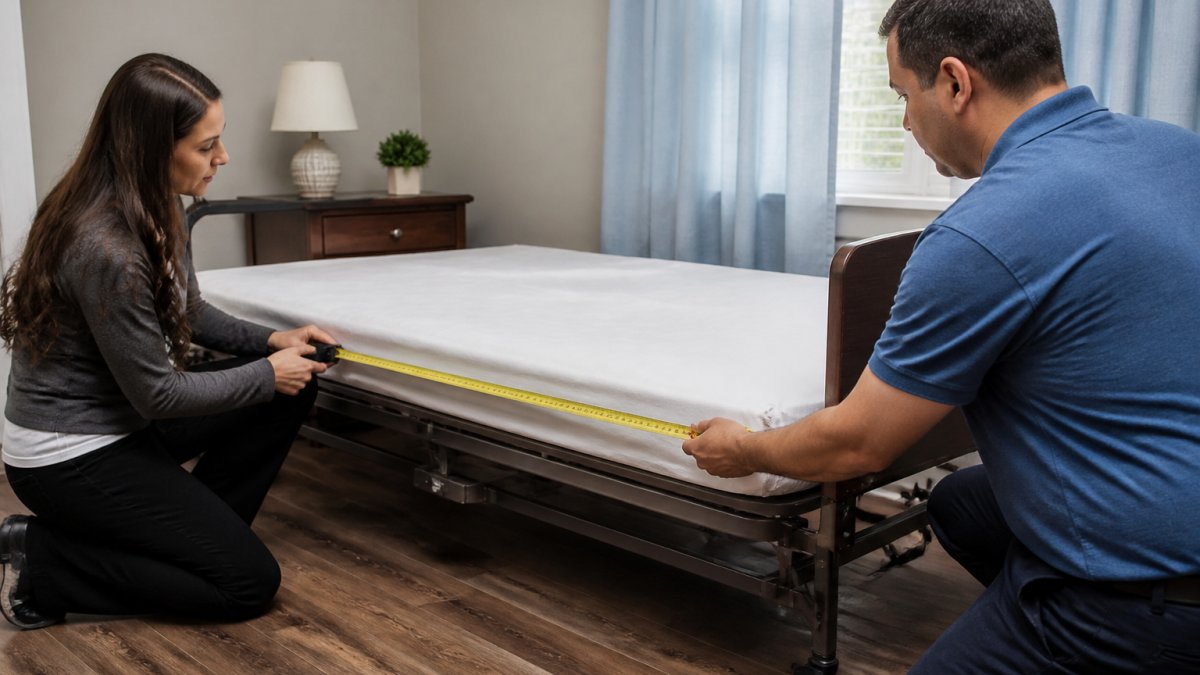
- Measure the open floor space where the bed will sit.
- Check the distance from the bed to a working outlet.
- Note the ceiling height if you plan a lift.
- Measure any furniture you plan to keep in the room.
Clearance for Caregiver Access and Transfers
Leave at least 3 feet of clear space on the side where a caregiver will help with transfers. If you use a lift or a wheelchair, allow more. This clearance is about patient safety, not just comfort. A caregiver who cannot stand beside the bed cannot help safely.
Medicare Coverage for Hospital Beds: What You Need to Know
Medicare Part B may cover a hospital bed as durable medical equipment (DME) when a doctor documents that it is medically necessary for use in the home (Durable Medical Equipment Coverage). The bed itself is typically classified as a “hospital bed” under the DME benefit, and the coverage rules are specific enough that most denials trace back to paperwork, not to the equipment.
Here is the pathway most suppliers and clinicians follow:
- A treating physician writes an order and documents medical necessity in the patient’s record.
- The patient meets with the doctor (or the doctor documents a face-to-face encounter) within the required window before the order is written.
- A Medicare-enrolled DME supplier confirms the patient’s coverage and delivers the equipment.
- The supplier bills Medicare, and the patient pays any coinsurance or deductible.
What “Medically Necessary” Usually Means for a Bed
Medicare does not cover a hospital bed simply because it is more comfortable. Common qualifying conditions include a patient who needs head-of-bed elevation for a medical reason, a patient who needs the bed’s height adjusted to transfer safely, or a patient whose condition requires side rails or positioning features that a standard bed cannot provide.
Rental First, Then Purchase
Medicare generally pays for capped rental of hospital beds rather than an outright purchase. Under the capped rental model, the supplier bills monthly for a set period, and after the cap is reached the patient typically owns the equipment. That structure is one reason renting first is common: it matches the way the benefit works and lets the patient test the fit before committing.
What Medicare Does Not Cover
Medicare generally does not cover a bed that is only for convenience, a bed used as a standard bedroom bed, or upgrades that go beyond what is medically necessary. A bariatric frame, for example, may be covered only when the patient’s weight and condition justify the heavier equipment, and the documentation has to say so.
Ask the supplier to confirm, in writing, what Medicare will pay and what you will owe before delivery. The supplier handles the paperwork, but the patient is responsible for the coinsurance and any non-covered upgrades.
Medicare guidance on hospital beds and durable medical equipment
Home Medical Equipment Rental vs. Buying
Renting home medical equipment first is often the smarter move. It lets you test a bed before you commit, and it suits short recoveries. Buying makes sense when the need is long term.
Weight Capacity, Positioning, and Safety Features
Weight capacity is the first number to check, and it is not the same as the mattress rating. A home hospital bed frame is rated for a total load that includes the patient, the mattress, and any accessories. Standard home frames commonly support around 350 to 450 pounds, while bariatric frames are built for higher capacities and are wider to match.
Positioning Features That Matter
Positioning is where a hospital bed earns its place in the home. The features to compare:
- Head-of-bed elevation, the main reason many patients qualify for a hospital bed. Look for a frame that raises smoothly and holds position under load.
- Foot-of-bed adjustment, useful for circulation and for patients who need the knees elevated.
- Trendelenburg and reverse Trendelenburg, a tilt of the whole bed surface. These are clinical features; confirm with the care team before relying on them at home.
- Bed height adjustment, a low starting height makes transfers safer and reduces fall distance. A frame that lowers close to the floor is a meaningful safety feature, not a luxury.
Fall Prevention Is a System, Not a Single Feature
Side rails are the most visible safety feature, but they are not automatically safer. A patient who is confused or who tries to climb over a raised rail can be at higher risk. Most practitioners treat fall prevention as a combination:
- A low bed height for transfers
- A stable frame that does not shift when the patient leans on it
- A mattress that matches the frame so the surface does not gap or slide
- A clear path on the caregiver’s side of the bed
- Rails used only when the care team says they help
Matching the Mattress to the Frame
A hospital mattress is built to flex at the frame’s articulation points. A standard mattress placed on a hospital frame can bind, gap, or slide when the head or foot section moves. Buy the frame and mattress as a matched set when you can, and confirm the mattress is rated for the frame’s weight capacity and articulation.
Never exceed the frame’s rated capacity, even briefly. Overloading a motorized frame can damage the motor, bend the frame, and create a fall hazard at the worst possible moment.
A Note on Floor Load
Weight capacity is not only about the frame. A heavy patient on a heavy bariatric frame concentrates load on a small floor area. Older homes and upper stories deserve a second look, and a contractor can confirm whether the floor is up to the load. This is the part of fitting most guides skip, and it is the part that can turn a safe setup into a structural problem.
Common Mistakes to Avoid When Fitting a Hospital Bed
The biggest mistake is buying before measuring. The second is forgetting the caregiver’s space. The third is skipping the outlet check.
- Measuring the mattress but not the frame
- Ignoring the path from door to bedroom
- Leaving no room for a caregiver to stand
- Overlooking floor load on upper stories
- Forgetting power for a motorized frame
- Skipping the matched mattress and frame
Measure the room, the path, and the power first. Every other decision gets easier once those three are settled.
Conclusion
Fitting a hospital bed at home comes down to the room, the frame, and the power. Get those right and the rest falls into place. Med-Tech Inc carries over 6,000 products and offers a try-before-you-buy rental option, so you can confirm the fit before you commit. Our team helps you match the frame, mattress, and safety features to your space and needs.
Frequently Asked Questions
What qualifies a patient for a hospital bed at home?
A doctor must document a medical need, such as a condition requiring head-of-bed elevation, positioning changes, or reduced fall risk. Medicare and most insurers require a prescription and clinical notes showing the bed supports treatment of a specific condition. Common qualifying conditions include COPD, severe arthritis, recovery from surgery, or a terminal illness. Without that documentation, the bed is considered a convenience item rather than medical necessity and is not covered.
How much will Medicare pay for a hospital bed at home?
Medicare Part B typically covers a portion of the approved rental amount for a medically necessary hospital bed after you meet your deductible. Coverage applies to a semi-electric bed with a mattress and side rails. Upgrades and fully electric beds may not be covered as standard equipment. Check your plan documents or call Medicare directly for current amounts.
What are the standard dimensions for home hospital beds?
A standard hospital bed frame is about 36 inches wide and 80 to 88 inches long, depending on headboard and footboard style. The mattress deck height adjusts from roughly 15 to 30 inches. These dimensions differ from a standard twin, which is 38 inches wide and 75 inches long. Always measure your room and doorway before delivery, since an assembled bed may not fit through a narrow hall or stairwell.
Do I need a prescription to get a hospital bed for home use?
Yes, if you want insurance or Medicare to cover the bed. A physician must write an order and provide clinical notes supporting medical necessity. You can buy or rent a bed without a prescription if you pay out of pocket. If you plan to use home medical equipment rental through a supplier, bring the prescription to your fitting appointment so staff can match the bed to your coverage and room.