
Table of Contents
- Best Grab Bars for Elderly: Types, Placement, and Installation
- Shower Chair vs Transfer Bench: Which One Do You Need?
- Medicare Coverage for Bathroom Safety Equipment
- Non-Slip Surfaces and Bath Mats That Prevent Falls
- Raised Toilet Seats and Commodes for Bathroom Safety
- Lighting, Decluttering, and Other Bathroom Modifications
- DIY vs. Professional Installation: What to Know
- Maintenance and Inspection: The Step Everyone Skips
- Frequently Asked Questions
Last Updated: September 12, 2026
Best Grab Bars for Elderly: Types, Placement, and Installation
The best bathroom safety for seniors starts with grab bars, and not the decorative kind. A grab bar is a length of metal tubing rated to support a person’s full body weight, mounted into wall framing or blocking to hold 250 pounds or more. That last part matters more than the bar itself.
Most bathrooms have a towel bar within arm’s reach of the toilet. A towel bar is not a grab bar, and it will not hold you. When someone grabs a towel bar during a stumble, it pulls out of drywall and the fall happens anyway.
Med-Tech Inc assists Southern Arizona families with these decisions.
Grab bar placement follows a standard pattern:
- Horizontal, 33 to 36 inches from the floor, beside and behind the toilet
- Vertical or angled, at the shower entry and along the back wall
- Horizontal, at the tub rim for seated transfers
Suction-cup grab bars belong in one place only: travel. They release without warning under a shifting load, so they are not a permanent fall prevention solution. Mount permanent bars into studs, or install blocking first.
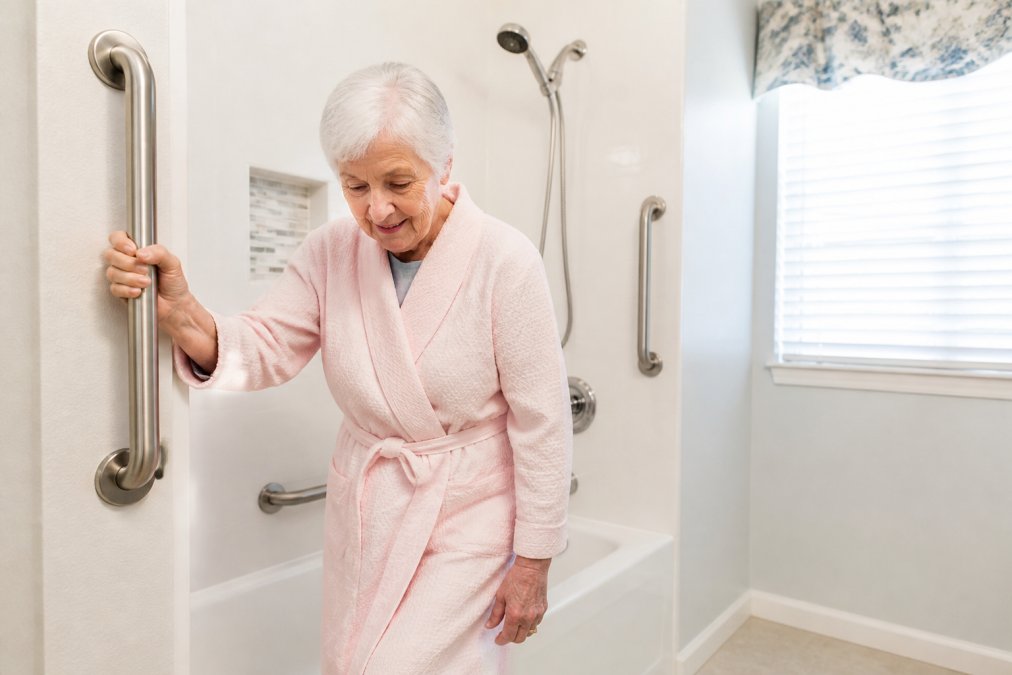
Never install a grab bar with drywall anchors alone. A bar that pulls free mid-fall turns a near-miss into a fracture. Fasten into studs or add blocking behind the wall first.
Shower Chair vs Transfer Bench: Which One Do You Need?
The choice between a shower chair and a transfer bench comes down to one question: can you step over the tub wall safely? A shower chair fits inside a shower or tub and works for someone with steady balance. A transfer bench straddles the tub rim so you sit down outside the tub, then slide across. It removes the step-over entirely.
Choose a shower chair if:
- You can stand and step with minimal support
- You use a shower (not a tub) or a tub with a low rim
- You have good trunk control and can sit upright without a backrest
Choose a transfer bench if:
- You cannot safely lift your legs over the tub rim
- You use a walker or wheelchair to reach the bathroom
- You need a backrest and padded seat for longer sitting
- You are recovering from hip, knee, or back surgery
What to measure before you buy:
- Tub rim height. Standard tubs are about 14 to 16 inches from floor to rim. Deep soaking tubs can be 20 inches or more and need a taller bench or a different solution.
- Tub rim width. The bench’s seat must span the rim with the outer legs on the bathroom floor and the inner legs inside the tub. Measure the rim thickness, not just the opening.
- User weight plus margin. Check the stated weight capacity against the user’s weight. A common guideline is to leave at least a 50-pound margin so the bench is not loaded to its limit every use.
- Doorway and turning space. A transfer bench is bulky. Confirm it fits through the bathroom door and that there is room to position it before you commit.
Features that matter:
- Suction-tipped or non-slip feet. A bench that slides defeats the purpose. Look for rubber tips that grip both tile and tub surfaces.
- Adjustable legs. Height adjustment lets you match the bench to your tub and to the user’s leg length, which reduces strain during transfers.
- Backrest and armrests. Armrests give a push-off point during the slide; a backrest supports users with weaker trunk control.
- Drainage holes. A seat that holds water gets slippery. Perforated or slotted seats drain faster.
- Padded seat. Matters for anyone who will sit for more than a few minutes.
CDC falls prevention resources for older adults
A few practical notes:
- Bring the user’s actual weight and the tub measurements to the store. Guessing is the most common reason a bench gets returned.
- If the user is between sizes or abilities, size up to the transfer bench. It works for a shower-chair user too, just with more footprint.
- Add a handheld shower head so the seated user can rinse without standing. This is not optional for a transfer bench, it is part of the setup.
- A non-slip mat inside the tub under the bench’s inner legs adds stability on smooth surfaces.
If you are unsure, rent first. Med-Tech Inc offers short-term rentals through our Southern Arizona showrooms so you can test a transfer bench in your own bathroom before committing.
Medicare Coverage for Bathroom Safety Equipment
Medicare coverage for bathroom safety equipment is narrower than most families expect, but it is not the only funding source. Knowing which program to ask about, and in what order, can save hundreds of dollars on a single bathroom.
Original Medicare (Part B). Grab bars, shower chairs, bath mats, and most bathroom modifications are classified as home modifications or convenience items, not durable medical equipment, so they are generally not covered. A commode or raised toilet seat sometimes qualifies as durable medical equipment when a physician documents medical necessity, the item is prescribed for use in the home, and the supplier is enrolled in Medicare. Coverage is decided case by case.
Medicare Advantage (Part C). Benefits vary by plan. Some plans include an over-the-counter or flex allowance that can be applied to bathroom safety items, and some offer supplemental home-safety benefits. Read your plan’s Evidence of Coverage, not the marketing summary.
Medicaid. Coverage depends on your state. Many states offer Home and Community-Based Services waivers that fund home modifications, including grab bar installation and bathroom accessibility upgrades, for people who meet functional and financial eligibility. Waiver slots are often limited and waitlists are common, so apply early. Contact your state Medicaid office or your local Area Agency on Aging to start.
Veterans benefits. The Department of Veterans Affairs offers two main paths for home modifications:
- HISA grant (Home Improvements and Structural Alterations), for medically necessary home modifications related to a service-connected or non-service-connected disability. A VA physician must determine the modification is medically necessary.
- SAH grant (Specially Adapted Housing), for certain severely disabled veterans, typically for larger accessibility projects.
Apply through your VA regional office or VA medical center. A VA occupational therapist can often assess the bathroom and document the need.
Tax deductions. Medical expenses, including certain home modifications made for medical care, may be deductible if they exceed the IRS threshold for medical expense deductions and the improvement does not increase your home’s value. Keep receipts and a physician’s letter. Talk to a tax professional about your situation.
Local programs. Area Agencies on Aging, faith-based organizations, and some city housing departments run minor home repair and fall-prevention programs that install grab bars at low or no cost. These are often underused because families do not know to ask.
official Medicare coverage guidelines
Before you pay out of pocket, ask your doctor for a written order that documents medical necessity. A prescription does not guarantee coverage, but it is the documentation Medicare reviewers look for first. For VA and Medicaid pathways, ask specifically for a home safety assessment, that assessment is often the trigger that unlocks funding.
Our knowledgeable staff can provide general information about which items typically qualify under various programs. We cannot promise a coverage outcome, but we can help you understand potential options.
Non-Slip Surfaces and Bath Mats That Prevent Falls
Non-slip surfaces address the fall risk that grab bars cannot: the floor itself. Wet tile and porcelain are slick, and most bathroom falls start with a foot sliding out from under a standing person.
A layered approach works best:
- Bath mats with rubber backing for the floor beside the tub. Replace them when the backing cracks or curls.
- Rubber decals or a non-slip mat inside the tub or shower floor. These grip better than suction mats, which peel up over time.
- Slip-resistant flooring if you are remodeling. Textured vinyl and certain tile finishes perform better than polished stone.
Avoid loose rugs near the toilet and shower entry. They bunch, slide, and catch walker wheels.
Raised Toilet Seats and Commodes for Bathroom Safety
A raised toilet seat adds height so you do not have to lower yourself as far, which reduces strain on knees, hips, and balance. It is one of the least expensive changes you can make, and one of the most effective for someone with arthritis or recent hip surgery.
Two options dominate:
| Option | Best For | Key Consideration |
|---|---|---|
| Raised toilet seat (toilet-mounted) | Stable users who need height only | Must fit the bowl shape; check locking mechanism |
| Commode chair (freestanding) | Users who cannot reach the toilet or need bedside use | Needs clearance and a stable floor surface |
A commode chair also works as a bedside option for nighttime use, which cuts down on trips across the house in the dark. For anyone recovering from surgery, that matters.
Lighting, Decluttering, and Other Bathroom Modifications
Lighting and clutter cause falls that no piece of equipment fixes. Motion-activated lighting means no fumbling for a switch in the dark. A night light near the toilet and along the path to the bathroom reduces nighttime falls, which are among the most dangerous because the person is disoriented and alone.
Bathroom decluttering is a safety measure, not just tidying. Clear the floor of laundry, magazines, and extra bottles. Move frequently used items to waist height so nobody reaches overhead or bends low. Keep a phone or emergency response system within reach of the floor, not on a high shelf.
Other modifications worth considering:
- Anti-scald valve to prevent burns, which matter for anyone with reduced sensation or slower reaction time
- Threshold reduction at the doorway if a walker or wheelchair must cross it
- Walk-in tub or walk-in shower for advanced mobility needs, though these are major projects
- Handheld shower head for seated bathing
For anyone with cognitive impairment, add simple visual cues and keep the layout consistent. A person with dementia may not remember new equipment placement, so avoid rearranging the bathroom.
DIY vs. Professional Installation: What to Know
Grab bar installation is the one task where DIY fails most often. The bar is easy to screw into a wall. Finding the studs, or adding blocking where there is none, is the hard part. Tile, plaster, and older walls hide what is behind them.
Hire a professional if:
- You cannot locate studs reliably
- Your walls are tile over drywall with no blocking
- You need multiple bars, a bench, or a walk-in conversion
- The user’s weight or balance makes a failure dangerous
Do it yourself only if you can confirm solid framing at every mounting point and you own the right tools. A stud finder, a drill with the correct bit, and stainless fasteners are the minimum.
home modification guidance from the National Institute on Aging
The bar is cheap. The mounting is everything. Budget for a professional if you cannot verify what is behind the wall.
Maintenance and Inspection: The Step Everyone Skips
Equipment fails quietly. A grab bar loosens one screw at a time. A bath mat backing dries out and cracks. A transfer bench foot loses its grip.
Check these monthly:
- Wobble every grab bar by hand. Any movement means re-tighten or re-mount.
- Inspect bath mat and shower mat backing for cracks or curling.
- Confirm transfer bench and shower chair feet are intact and gripping.
- Test motion-activated lights and night lights.
- Check the raised toilet seat locking mechanism.
- Verify the emergency response system battery and range.
Replace rather than repair when a mounting point has pulled loose once. The wall has already failed there.
Bathroom safety is not a single purchase. It is a set of decisions about height, grip, lighting, and mounting, and getting one wrong can undo the rest. Med-Tech Inc offers a comprehensive selection of quality healthcare products and medical solutions, with over 6,000 products in stock across the largest medical supply showrooms in Southern Arizona. Our ‘try before you buy’ rental program allows you to test equipment like transfer benches, shower chairs, or raised seats to ensure they fit your bathroom and your body. Our knowledgeable staff is committed to understanding your unique needs and providing expert assistance in finding the right equipment. Get started with Med-Tech Inc and build a bathroom you can use safely and independently.
Frequently Asked Questions
How can I make my bathroom safe for elderly people?
Start with the highest-impact changes: install grab bars near the toilet and shower, add a non-slip bath mat, and use a shower chair. Improve lighting with motion-activated night lights, remove clutter, and set the water heater to a safe temperature. For more complex modifications like walk-in tubs or threshold ramps, consult a professional. A home safety assessment can identify specific risks in your bathroom layout and recommend the right bathroom safety products for your needs.
What are the most essential bathroom safety products for seniors?
The essentials include grab bars for the shower and toilet area, a shower chair or transfer bench, a raised toilet seat, non-slip flooring or bath mats, and handheld shower heads. Motion-activated lighting and an emergency response system add extra security. Many of these items are available through medical supply stores, and some may be covered by Medicare or insurance if you meet the criteria. Prioritize products that match the senior’s mobility level and bathroom layout.
Are there ADA guidelines for residential bathroom safety?
The Americans with Disabilities Act (ADA) sets accessibility standards for public and commercial facilities, not private homes. However, the ADA guidelines are a useful reference for residential modifications. For example, grab bars should be mounted 33 to 36 inches above the floor, and shower seats should be stable and securely attached. Following these dimensions can make a home bathroom safer and more accessible, even though they are not legally required for private residences.
What are the best non-slip solutions for bathroom floors?
Non-slip solutions include rubber decals or strips for the tub floor, slip-resistant bath mats with suction cups, and textured tiles or non-slip coatings for the entire bathroom floor. Rubber decals are inexpensive and easy to apply, while a full non-slip coating offers the most coverage. Always ensure mats lie flat and have drainage to prevent mold. For the shower, a transfer bench or shower chair with rubber tips adds stability. Test surfaces while wet to confirm they meet your needs.