Table of Contents
- What Makes a Reacher Work for Hand Arthritis
- Trigger Mechanism and Grip Strength: The Critical Difference
- Ergonomic Grabber Tools for Seniors with Limited Dexterity
- How to Use a Reacher Tool Effectively When Gripping is Painful
- Best Assistive Devices for Hand Arthritis Beyond the Reacher
- Length, Weight Capacity, and Reach Requirements
- Folding vs. Non-Folding Models and Durability Expectations
- Frequently Asked Questions
Last Updated: September 18, 2026
What Makes a Reacher Work for Hand Arthritis
A reacher for hand arthritis must solve a specific problem: extending your reach without forcing your hands to grip, pinch, or strain. The best reacher for hand arthritis combines a low-tension trigger mechanism with an ergonomic handle designed for weak or painful hands. This isn’t about generic grabbing tools, it’s about equipment engineered for people managing joint pain, limited dexterity, or reduced grip strength. (Source: the American College of Rheumatology’s guidelines)
Hand arthritis creates a painful paradox. You need to reach items on high shelves or bend down to pick things up, but the movements that would normally solve this problem cause pain or feel impossible. A poorly designed reacher forces you to squeeze a stiff trigger or grip an uncomfortable handle. The right one lets you operate it with minimal hand effort, using your arm and shoulder strength instead.
Most people choose reachers based on length alone, missing the critical factors that determine usability. The trigger mechanism matters more than reach length. The handle design matters more than weight. These details separate tools that work from tools that frustrate.
Trigger Mechanism and Grip Strength: The Critical Difference
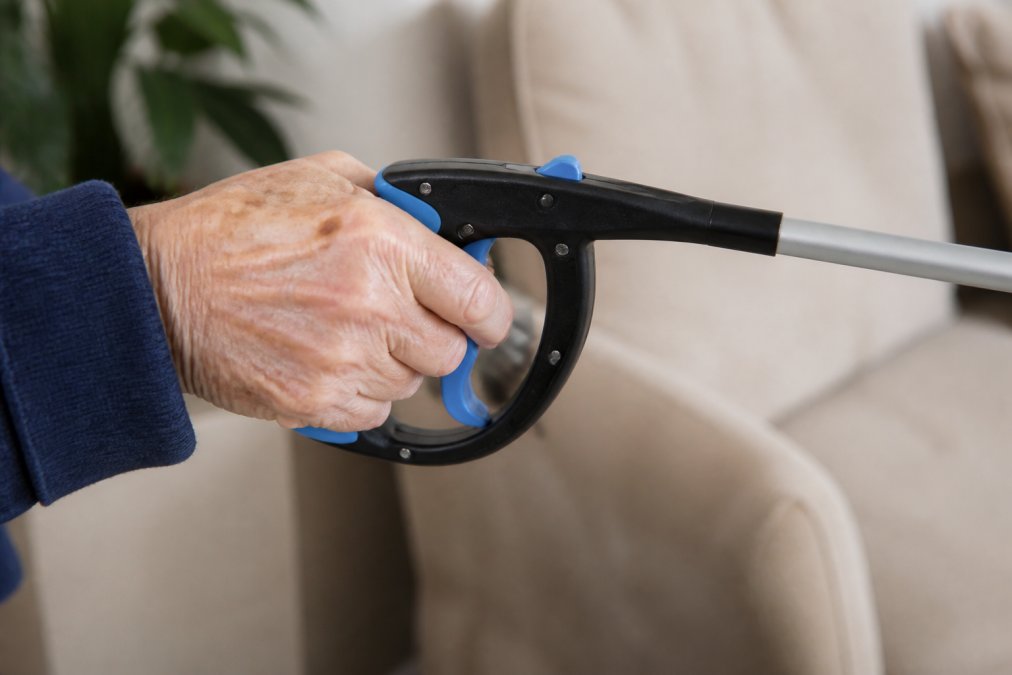
The trigger is where most reacher designs fail for arthritis patients. A stiff trigger defeats the purpose entirely. The best models use low-tension triggers that require minimal hand strength to operate, measured in pounds of force required to actuate the jaw.
Understanding Trigger Tension and Actuation Force
Most standard reachers require 3-8 pounds of squeeze force, which is too high for moderate hand arthritis. Premium ergonomic reachers operate at 1-3 pounds of actuation force, a significant difference that determines daily usability.
A trigger requiring 5 pounds of force equals the pressure needed to hold a coffee mug, painful after an arthritis flare. A trigger requiring 1.5 pounds feels like a gentle closing motion you can repeat dozens of times without fatigue or pain.
Trigger Mechanism Types and Arthritis-Specific Considerations
Different trigger designs distribute force differently across your hand, which matters depending on where your arthritis is located.
Squeeze-trigger (pistol grip): The most common design, concentrating force on the MCP and PIP joints. For people with osteoarthritis in these joints, the repetitive pinching motion stresses the exact joints causing problems.
Whole-hand trigger (palm-squeeze): Requires closing your entire hand, distributing pressure across all fingers and palm. This spreads load across more joints, reducing peak stress. People with MCP or PIP joint arthritis often find this more tolerable than squeeze triggers.
Lever-and-button hybrid: A two-stage mechanism using a light thumb button followed by a gentle squeeze, reducing peak force and distributing effort across different hand muscles.
Ratcheting mechanisms: Valuable for severe arthritis, allowing incremental jaw closure without sustained grip pressure.
Matching Trigger Type to Your Arthritis Pattern
If your pain is concentrated in your fingertips and knuckles (MCP/PIP joints), avoid squeeze triggers. Look for whole-hand triggers or ratcheting designs that distribute force across your palm.
If your pain is in the base of your thumb (CMC joint), test the trigger carefully. Some whole-hand triggers require significant thumb involvement; others don’t. A squeeze trigger that uses only your fingers (not your thumb) may work better if your CMC joint is the primary problem.
If you have wrist pain or limited wrist mobility, test whether the trigger requires wrist rotation. Some reachers force a slight wrist twist to operate the trigger; others allow a straight wrist position. This matters more than people realize.
Jaw Design and Its Effect on Trigger Effort
Lightweight jaw materials require less force to operate. A jaw opening to 4 inches requires less trigger force than one opening to 6 inches. For most household items, a 4-inch opening is sufficient; wider openings demand more hand strength.
Testing Trigger Tension Before Purchase
Never buy a reacher without testing the trigger in person. If buying online, look for a 30-day return policy. When testing, operate the trigger 10-15 times in succession to reveal fatigue patterns. A good trigger should feel the same on the 15th squeeze as the first.
Ergonomic Grabber Tools for Seniors with Limited Dexterity
A reacher for hand arthritis should feel like an extension of your arm. This requires matching three interconnected features: handle design, jaw functionality, and reach length.
Handle Diameter, Length, and Material
Handles between 1.25 and 1.5 inches in diameter work best for arthritis. Thinner handles create pressure points; thicker ones are hard to grip. Handle length should allow your hand to rest naturally, most quality reachers offer 4-5 inches, which works for most hand sizes.
Textured rubber or foam grips prevent slipping without requiring harder squeezing. Hard plastic requires more grip pressure, defeating ergonomic design. Contoured handles with finger grooves guide grip and reduce conscious positioning, improving usability for people with severe arthritis.
Weight and Its Effect on Fatigue
Weight should stay below 1 pound for daily use; anything over 1.5 pounds causes shoulder fatigue. Weight distribution matters as much as total weight, the tool should feel balanced, not nose-heavy. Aluminum construction keeps weight down while maintaining durability better than all-plastic models.
Jaw Design: Padding, Width, and Material
Rubber or foam-lined jaws grip without slipping and protect fragile items; hard metal jaws slip and damage items. Most reachers open to 3.5-4.5 inches, handling typical household items. Wider jaws require more hand strength; narrower jaws are easier to control but limit what you can grab.
Rubber-coated metal jaws last longer and grip better than all-rubber or bare metal. Some premium models use replaceable jaw pads.
Rotating Jaw Functionality
A rotating jaw lets you grab items at awkward angles without twisting your wrist, valuable for limited wrist mobility. Rotating jaws add complexity and wear over time; non-rotating jaws are simpler and more durable. Test rotation before buying, it should move smoothly with minimal resistance.
Reach Length and Real-World Task Requirements
Most household tasks require 26-28 inches of reach; a 26-inch reacher handles 80 percent of daily living activities. Longer reachers (30-32 inches) create control challenges for weak grip strength. A 26-inch model is sufficient for 90 percent of home use; a 28-inch is a reasonable compromise for high shelves.
These three features work together: longer reachers need lighter weight and lower-tension triggers; wider jaw openings require stronger grip. Test all three features together in realistic scenarios. The best reacher for hand arthritis is the one where all three elements work in harmony.
How to Use a Reacher Tool Effectively When Gripping is Painful
Hold the reacher with your entire hand, distributing pressure across your palm and fingers rather than squeezing with fingertips. Position the reacher perpendicular to the item for maximum efficiency. Operate the trigger with smooth, controlled motion, slow, deliberate pressure distributes load across more hand muscles. For high shelves, bend your knees and use your legs rather than extending your arm overhead. Test your grip before lifting to prevent dropping items.
Best Assistive Devices for Hand Arthritis Beyond the Reacher
A reacher is one tool in a broader toolkit. Forearm braces redistribute load away from hands and wrists. Ergonomic jar openers, bottle openers, and door handle extensions solve specific problems reachers don’t address. Lightweight grabbers complement longer reachers for precision work. Some people benefit from multiple reachers optimized for different tasks. Occupational therapy can identify the best combination for your specific situation.
Length, Weight Capacity, and Reach Requirements
Most household tasks require 26-28 inches of reach; a 26-inch reacher handles 80 percent of daily activities. Most quality reachers safely handle 3-5 pounds. Weight of the tool itself affects usability, 8 ounces feels light; 1.5 pounds creates fatigue. Aluminum construction keeps weight down while maintaining durability better than all-plastic models.
Folding vs. Non-Folding Models and Durability Expectations
Folding reachers collapse to 16-18 inches for portability; non-folding models are simpler mechanically. Folding mechanisms add failure points, quality non-folding reachers last 5-10 years; folding models last 3-5 years. Choose folding if you travel or need portability; choose non-folding for daily home use and better reliability.
Choosing the right reacher for hand arthritis means matching the tool to your specific hand strength, reach requirements, and daily activities. The trigger mechanism and handle design matter far more than length or weight capacity. A low-tension trigger you can operate with minimal pain, combined with an ergonomic handle designed for weak hands, transforms a reacher from a frustrating tool into something you’ll actually use.
Choosing the right reacher for hand arthritis means matching the tool to your specific hand strength, reach requirements, and daily activities.
Frequently Asked Questions
What trigger mechanism works best for someone with hand arthritis?
Low-tension trigger mechanisms are essential for arthritis sufferers. Look for reachers with adjustable or naturally soft trigger resistance that requires minimal finger pressure to operate. Squeeze-style triggers distribute force across your whole hand rather than concentrating it on individual fingers, reducing joint strain. Test the trigger action before purchasing, it should activate smoothly without requiring a tight grip or sustained pressure that aggravates arthritis symptoms.
How do I choose the right length for a reacher grabber?
Reacher length depends on your reach needs and arm strength. Standard lengths range from 26 to 32 inches. Measure the distance from your fingertips to objects you frequently need to reach, doorknobs, cabinet shelves, dropped items. Longer reachers (32 inches) reduce bending but require more arm strength to control. Shorter models (26-28 inches) offer better precision and control, making them ideal for people with hand weakness from arthritis. Consider your mobility and where you’ll use it most.
Can a reacher grabber really help with daily living activities if I have hand arthritis?
Yes. Reachers significantly reduce the need to grip, pinch, and strain arthritic hands during daily tasks like picking up dropped items, retrieving objects from high shelves, or reaching behind furniture. By extending your reach, a quality reacher minimizes repetitive gripping motions that trigger pain and joint inflammation. Many people with arthritis find reachers enable independent living by reducing reliance on others for basic household tasks. Effectiveness depends on selecting one with appropriate trigger tension and handle design for your specific grip limitations.
What’s the difference between trigger-style and squeeze-style reachers for arthritis?
Trigger-style reachers use a finger-operated trigger mechanism that concentrates force on individual fingers, which can aggravate arthritis. Squeeze-style reachers distribute pressure across your entire hand and palm, reducing strain on arthritic joints. For hand arthritis, squeeze-style or lever-action models are generally better because they engage larger muscle groups rather than small finger joints. Test both styles if possible, some people with specific grip patterns may find one more comfortable than the other.