
Table of Contents
- Understanding Hand Arthritis and Grip Strength Loss
- Types of Assistive Devices for Daily Living with Hand Arthritis
- Ergonomic Kitchen Tools for Arthritis and Cooking Independence
- Hand Strengthening Exercises for Arthritis and Joint Protection
- Choosing the Right Grip Size and Handle Material
- Maintenance and Hygiene of Adaptive Equipment
- Insurance Coverage and Reimbursement for Medical Equipment
- Frequently Asked Questions
Last Updated: September 25, 2026
Understanding Hand Arthritis and Grip Strength Loss
Hand arthritis fundamentally changes how people interact with everyday objects. When joints in the fingers, wrist, or palm become inflamed, the result is reduced grip strength, limited range of motion, and pain that makes simple tasks feel impossible. This isn’t just inconvenience, it’s a barrier to independence.
The connection between joint inflammation and grip loss is direct. Arthritis damages the cartilage that cushions joints, causing friction, swelling, and stiffness. Grip strength declines because the muscles that power your hand must work around damaged joints. Fine motor skills suffer alongside gross strength, making activities of daily living increasingly difficult.
At Med-Tech Inc, we work with people managing arthritis every day. We’ve learned that choosing medical equipment for arthritis hand strength isn’t about finding one perfect tool, it’s about building a system of adaptive equipment that matches your specific symptoms and lifestyle. The right assistive technology can restore functional independence and reduce pain simultaneously.
Understanding your baseline matters. Some people lose grip strength gradually over months. Others experience sudden losses after flare-ups. The pattern determines which adaptive equipment works best. Someone with progressive weakness needs different tools than someone managing episodic inflammation.
Hand arthritis reduces grip strength through joint inflammation and cartilage damage. Choosing medical equipment for arthritis hand strength requires matching tools to your specific symptom pattern, not just picking products off a shelf.
Types of Assistive Devices for Daily Living with Hand Arthritis
Assistive technology for arthritis falls into distinct categories, each solving specific functional problems. Understanding these categories helps you identify what your daily life actually requires.
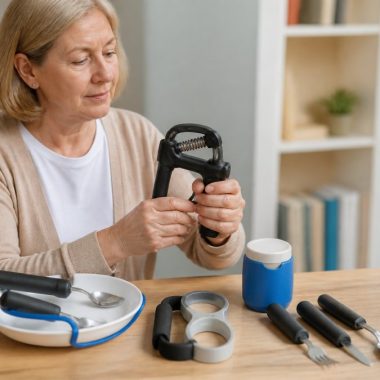
Grip-enhancement devices are the foundation. These include built-up handles, adaptive utensils, and ergonomic grips that increase surface area and reduce the force required to hold objects. A standard pen requires significant pinch strength; an adaptive pen with a wider barrel distributes pressure across more hand surface, reducing joint stress. Jar openers use mechanical advantage to replace grip strength with use.
Joint protection tools stabilize vulnerable joints during activities. Compression gloves provide external support while improving proprioception, your body’s sense of hand position. Splinting devices immobilize specific joints, preventing the micro-movements that trigger inflammation. These work best during flare periods or high-activity days.
Reaching and retrieval aids address the secondary problem: when hand pain limits what you can access, mobility aids become essential. Reachers with ergonomic handles let you retrieve items without bending or gripping. Long-handled shoehorns, sock aids, and dressing tools reduce hand involvement in getting dressed.
Specialized kitchen tools deserve their own category because cooking involves sustained gripping, twisting, and fine motor control. Ergonomic kitchen equipment includes one-handed can openers, rocker knives, ergonomic vegetable peelers, and mixing bowls with non-slip bases. These tools reduce hand fatigue during meal preparation.
The mistake most people make is treating assistive devices as temporary fixes. They’re not. They’re permanent modifications to your environment that make independent living possible. The right equipment becomes invisible, you stop thinking about arthritis and start thinking about the task.
Ergonomic Kitchen Tools for Arthritis and Cooking Independence
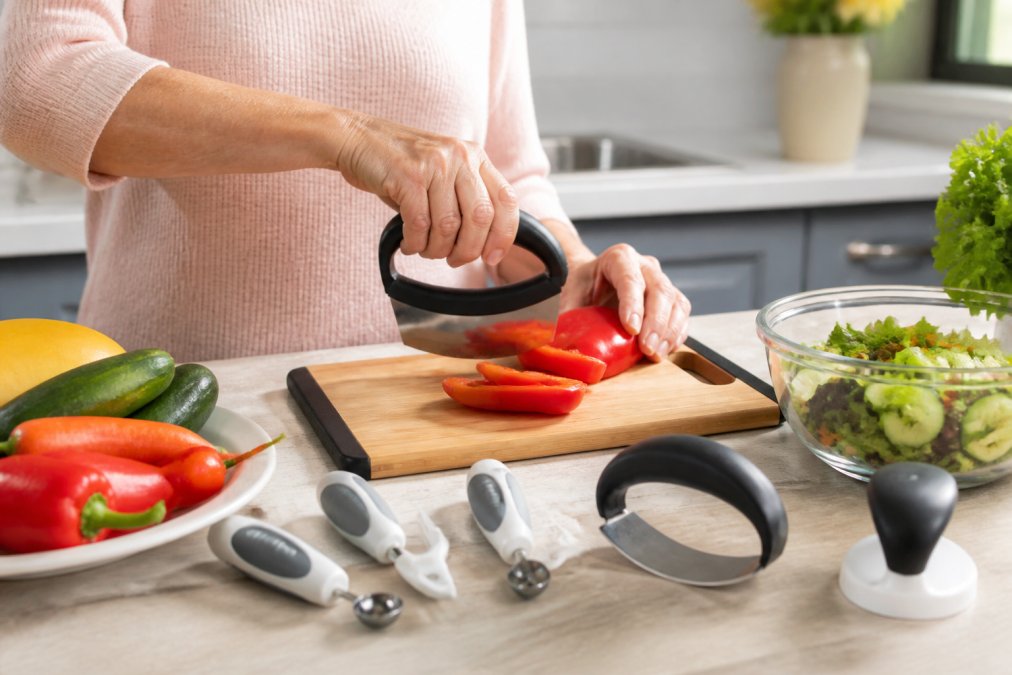
Cooking demands sustained grip strength, fine motor control, and repetitive hand movements. For people with hand arthritis, this combination can make meal preparation painful or impossible. Ergonomic kitchen tools restore this independence by redistributing force and reducing joint stress.
A rocker knife replaces the rocking motion that requires wrist stability. Instead of gripping a handle and rocking, you push down with your palm. The blade does the work. One-handed can openers eliminate the pinching grip required by traditional openers, your hand simply holds the can stable while a handle mechanism rotates the blade. Ergonomic vegetable peelers feature wider handles and reduced grip force requirements compared to standard peelers.
The mechanical advantage principle underlies all effective kitchen tools. A longer handle multiplies your force. A wider grip reduces the pressure on individual joints. Non-slip surfaces mean you need less grip strength to maintain control. When you combine these features, you can perform kitchen tasks that isolated grip strength alone would prevent.
Mixing bowls with non-slip bases stay put during preparation, eliminating the need to stabilize with your weaker hand. Ergonomic whisks and wooden spoons feature built-up handles that distribute force across your palm rather than concentrating it in your fingers. Kettle tippers and pot stabilizers solve the problem of pouring hot water, a major safety concern when hand strength is compromised.
Setup matters as much as equipment. Arrange your workspace so frequently-used items sit at elbow height. This eliminates reaching and reduces shoulder strain that compounds hand problems. Keep adaptive tools visible and accessible, if you have to search for them, you’ll skip them and use painful conventional tools instead.
:::pro-tip
Test kitchen tools before buying. Grip the handle as you would during actual use. If your hand tires within 30 seconds, the handle is too small or the grip too demanding. The right tool feels effortless, not just possible.
Hand Strengthening Exercises for Arthritis and Joint Protection
Exercise for hand arthritis requires a careful balance. You need enough activity to maintain range of motion and prevent stiffness, but not so much that you trigger inflammation. The goal isn’t building grip strength, it’s preserving functional mobility while protecting joints.
Therapeutic putty provides controlled resistance. Unlike weights or springs, putty allows you to adjust resistance by how deep you push. Start with soft putty and basic exercises: squeeze and release, pinch and hold, roll and flatten. These movements engage hand muscles without forcing joints through painful ranges. Most people benefit from 10-15 minute sessions, 3-4 times per week.
Gentle range-of-motion exercises prevent the stiffness that compounds arthritis problems. Make a fist slowly, then spread fingers wide.
Choosing the Right Grip Size and Handle Material
Grip size is not a minor detail, it’s a primary determinant of whether adaptive equipment actually works. A handle that’s too small concentrates force on your fingers, defeating the purpose of adaptive equipment. A handle that’s too large requires excessive hand opening, which many people with arthritis cannot achieve.
Maintenance and Hygiene of Adaptive Equipment
Adaptive equipment requires regular maintenance to remain functional and safe. Neglected tools become less effective and potentially hazardous.
Worn or damaged adaptive equipment can cause injury. A slipping grip during cooking can lead to cuts. Mechanical tools with loose parts may pinch skin. Inspect equipment regularly and replace items showing wear. The cost of replacement is far less than the cost of injury.
Insurance Coverage and Reimbursement for Medical Equipment
Many adaptive devices and assistive technologies qualify for insurance coverage, but the pathway to reimbursement requires understanding your specific plan and documentation requirements.
Frequently Asked Questions
What assistive devices are best for hand arthritis?
The best assistive devices depend on your specific symptoms and daily activities. Built-up handles reduce grip force needed for utensils and tools. Compression gloves provide joint support and reduce inflammation. Reachers extend your reach without gripping. Jar openers use mechanical advantage to reduce pinch strength demands. Adaptive equipment works best when matched to your exact functional limitations, try before you buy when possible to ensure the device fits your hand size and activity needs.
How can I improve my grip strength with arthritis?
Hand strengthening exercises for arthritis should focus on gentle, progressive movements that build dexterity without causing pain. Therapeutic putty exercises, resistance bands, and range of motion activities help maintain functional strength. Occupational therapy can guide safe exercise progressions. Combine exercises with joint protection techniques, using larger muscle groups for tasks, taking frequent breaks, and avoiding repetitive strain. Consistency matters more than intensity; most people see improved grip strength and reduced hand fatigue with regular, gentle practice.
What should I look for when buying adaptive kitchen tools?
When selecting ergonomic kitchen tools for arthritis, prioritize built-up handles that reduce required grip force, non-slip textures for better proprioception and control, and lightweight materials to minimize hand fatigue. Look for tools with mechanical advantage features like long handles on can openers. Consider your dominant hand’s pain points, some people need help with pinching, others with gripping or twisting. Test the tool in your hand before purchasing if possible, as handle diameter and weight distribution significantly affect usability and comfort.
How do I know which grip size is right for me?
The correct grip size depends on your hand measurements and the specific task. Generally, your fingers should wrap around the handle with your thumb and index finger almost touching. Too-small handles increase required grip force and cause fatigue; too-large handles limit control and dexterity. Built-up handles typically range from 1.25 to 2 inches in diameter. Ask your occupational therapist to measure your hand, or test multiple sizes at a medical supply showroom before committing to equipment.
Does using medical equipment for arthritis prevent further joint damage?
Medical equipment and adaptive tools reduce stress on arthritic joints during daily activities, which can slow progression of joint inflammation and protect tendons. Joint protection techniques, using larger muscle groups, avoiding repetitive strain, and taking breaks, work alongside equipment to minimize damage. While equipment cannot reverse existing arthritis, it helps maintain functional independence and range of motion. Combined with occupational therapy guidance and medical treatment, adaptive equipment is an important part of managing hand arthritis long-term.
How do I maintain and clean adaptive equipment?
Most adaptive equipment should be cleaned with warm soapy water and dried thoroughly to prevent mold and bacterial growth. Built-up handles and grips can harbor moisture; wipe them dry after each use. Compression gloves should be hand-washed and air-dried. Check equipment regularly for wear, cracks, or deterioration of non-slip surfaces. Replace worn grips or handles promptly, as degraded texture reduces proprioception and increases slip risk. Proper maintenance extends equipment life and ensures hygiene for daily living aids.
Does Medicare or insurance cover adaptive equipment for arthritis?
Medicare Part B covers durable medical equipment (DME) prescribed by a physician for medical necessity, which may include certain adaptive devices. Coverage depends on specific diagnosis, medical documentation, and the equipment type. Private insurance policies vary significantly. You’ll typically need a prescription from your doctor and may face copayments or deductibles. Contact your insurance provider directly for coverage details, and ask your medical supply provider about reimbursement pathways.